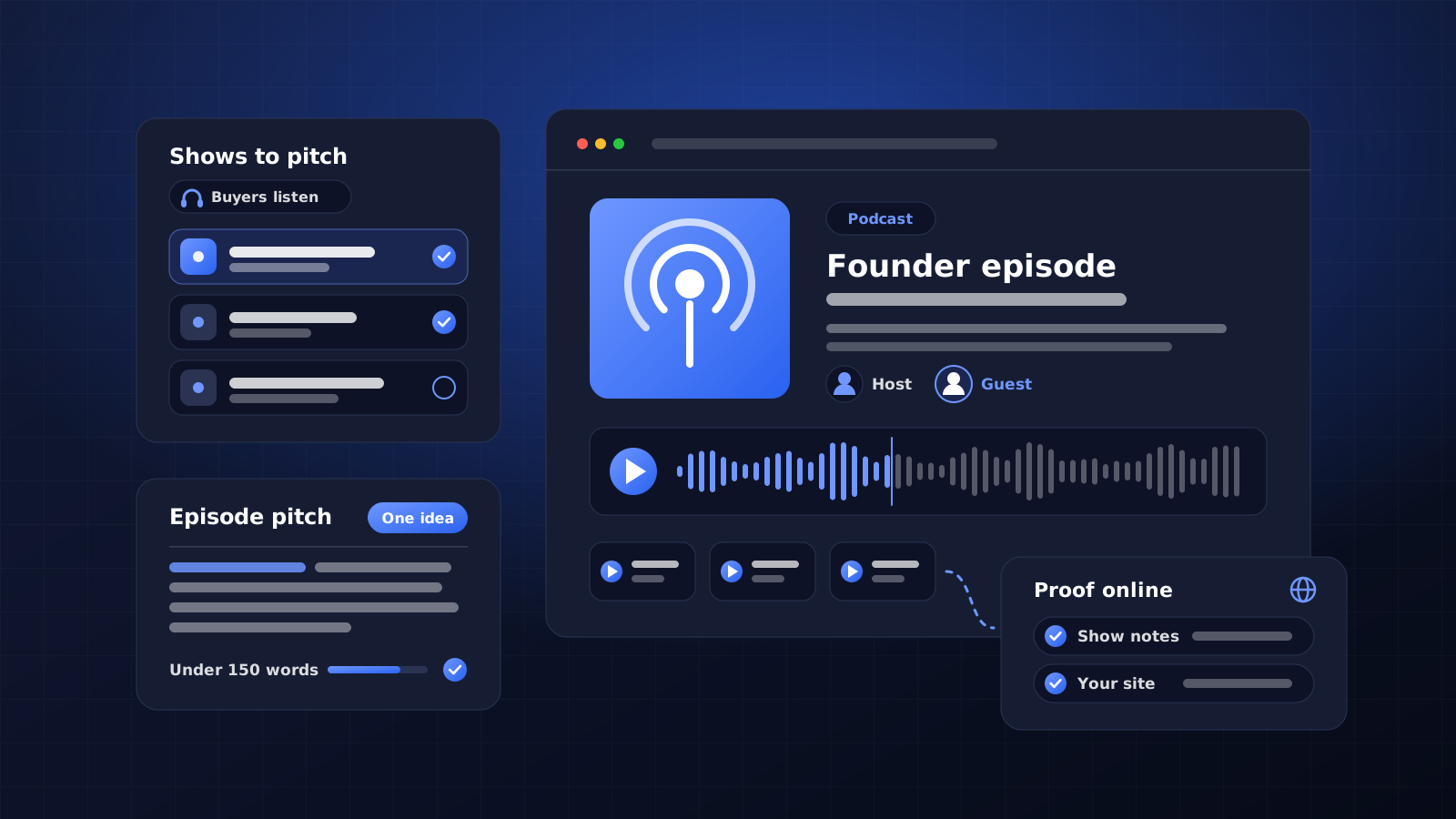
To get on podcasts as a founder, list 20 to 30 active shows your buyers already listen to, then send each host a short pitch built around one episode idea for their audience. Hosts say yes to guests who make their work easier, so have your bio, photo and talking points ready before the first email goes out.
01.What a podcast appearance does for a founder
A long interview lets a buyer hear how you think for 40 minutes, which no homepage can manage. Someone who has listened to you work through a problem arrives at the first sales call already half convinced.
The audience is there on both sides of the Atlantic. Ofcom's 2025 listening research found that over a fifth of UK adults listen to podcasts every week, rising to 30 per cent of 35 to 44-year-olds, and that the average listener gets through five podcasts a week.
Each episode also gets its own page, with your name in the title or show notes and usually a link to your website. Pages like that can rank for your name years after the recording, and our guide to ranking your name on Google explains why they matter when investors search for you.
One appearance rarely brings in a client the week it airs, so expect a slow return. The value builds over ten or twelve episodes, when a prospect who looks you up finds you explaining the same problem to several different hosts.
02.Pick shows your buyers already listen to
Start with the people who already pay you. Ask five recent clients which podcasts they listen to for work, then search Apple Podcasts, Spotify and YouTube for your buyer's job title plus their sector, such as "practice manager podcast" or "restaurant owner podcast". Put every show into a spreadsheet with the host's name, the booking contact, the last episode date and two recent guests.
Then cut the list hard. A July 2026 review of 314 podcast feeds found that only 32 per cent of shows publish any evidence that they book outside guests, and 23 per cent had not released an episode in about six months. Pitching either kind of show wastes the email, however good the idea.
Keep a show only if it passes these checks:
- The latest episode came out in the last four weeks.
- At least half of the last ten episodes feature a guest from outside the show, and the show notes give a booking email or a guest form.
- Past guests sit at roughly your level. A show that interviews public-company CEOs will pass on a seed-stage founder, and a show for first-time founders has little use for a bank's chief economist.
- Reviews and guest job titles point to your buyer, whatever the download count suggests.
That review scored long-running independent shows as the most open to outside guests and network-owned shows as the least, which cuts against the usual advice to start with the smallest podcasts you can find. Aim for 20 to 30 shows of mixed size, weighted towards the ones your clients named, and listen to one full episode of each before you write to the host.
03.Build each pitch around one episode idea
"Founder of a fintech start-up" gives a host nothing to plan around. A specific question with a story behind it gives them an episode title, and a title is what they need before they can book anyone.
For example, picture an invented founder who runs a 15-person payroll bureau. A show aimed at HR managers might get "the payroll errors that start when a company hires its tenth employee". To a hospitality podcast, the same founder pitches "why restaurant tips break most payroll software". The expertise is identical, but each idea is written for one audience.
A host is booking an episode for their listeners, and the guest who hands them that episode gets the slot.
Test each idea by writing the title the host would publish. If no listener would click it, the idea is still about you. Leave your company name out of the idea entirely, since the host will mention it in the introduction anyway.
04.How to pitch a podcast host
Send the pitch where the show asks for it: a guest form, the booking email in the show notes, or the producer if one is credited. Bigger shows route guests through producers, and a pitch sent to the host's personal inbox can sit unread for weeks.
Keep it under 150 words. Many hosts read pitches on a phone between recordings, and a long email gets saved for later and forgotten. Build it in this order:
- A subject line that is the episode idea, such as "Episode idea: the payroll mistake firms make at ten staff".
- Open with one line about a recent episode, naming something the guest said that stayed with you.
- The idea in two sentences, followed by two or three questions the host could ask.
- A fact the host can check in a minute: a company they can look up, a number from your own business or an earlier interview.
- Close with a link to your guest page and a date range, such as "Happy to record any week in March".
Follow up once, about a week later, with something new, such as a second angle or a recent result. Silence after two emails means no for now. A third makes your next pitch to that host harder. Our guide to getting press coverage as a founder covers the journalist version of this email.
05.Give hosts a guest page they can copy
Before the first pitch goes out, put a guest page on your own website, or a one-page PDF if you have no site yet. Hosts copy from it into show notes and social posts, so whatever you put there ends up in public. A useful guest page holds:
- Your name and job title exactly as you want them written, which stops each show inventing its own version.
- A bio in two lengths: about 50 words for the host to read aloud and about 100 for the show notes. The founder bio guide walks through both.
- A headshot in wide and square crops, at least 1,500 pixels across, against a plain background.
- Three or four episode ideas, each with the questions a host could ask.
- How to say your name, if people regularly get it wrong.
- Links to past episodes with the best one first, plus your website and LinkedIn.
Write the facts on this page once and copy them everywhere else. When one show says you founded the company in 2019 and another says 2020, a careful investor notices, and search engines get mixed signals about who you are.
06.Sound like a guest hosts invite back
Start with the microphone. A basic USB model sounds far better than the one built into your laptop. Wear wired headphones so the host's voice does not echo into your track, and plug into the router if you can. Record in the smallest room you have with the most soft furnishings, and close every other app before the call starts.
Plan for a camera as well, because many shows now publish video. Edison Research's Infinite Dial 2025 found that 55 per cent of Americans aged 12 and over consume a podcast every month and 51 per cent have watched one. Raise your laptop to eye level and sit facing a window.
Prepare stories rather than answers. One story with a real number in it, told in about 90 seconds, does more than ten polished talking points. Answer the question you were asked, then stop and let the host steer. Mention your company when it belongs in the story, and give one place listeners can find you at the end, once.
07.Paid guest spots and guaranteed bookings
Some shows charge guests to appear. In a 2022 interview with NPR, Bloomberg reporter Ashley Carman said her reporting found fees of up to $50,000 for a single appearance, particularly in wellness, crypto and business podcasts, and that listeners were not always told.
Treat a paid spot as advertising. Judge it like any other ad buy: ask for listener numbers you can verify, and ask whether the host will say on air that the episode is paid. If the host will not disclose the payment, walk away, because a listener who finds out later stops trusting both of you.
Be just as careful with anyone who promises a set number of bookings on well-known shows. Hosts decide who they interview, and no agency controls that, ours included. Good help can find the right shows and prepare you for the recording, which raises your odds, but no one can guarantee a booking.
08.Turn each episode into proof that lasts
When the episode goes live, check that the show notes spell your name the way your website does and link to the page you want people to find. If either is wrong, send the host a short, polite correction that week, because a mistake in the show notes lasts as long as the page does.
- Add the episode to a media page on your website, newest first.
- Clips of under a minute, captioned for people scrolling on mute, work well on LinkedIn, and two or three per episode is plenty.
- Send the link to one prospect who asked the question the episode answers.
- Your enquiry form needs a "Where did you hear about us?" field, or you will never know which shows lead to calls.
Share the episode in its first week and tag the host. Hosts talk to each other, and the guest who promoted their episode is the one they recommend to the next show.
If you would like a second pair of hands on the show list and the pitches, start with our PR and media features service.
Frequently asked questions
Do podcast guests get paid?
Most interview shows do not pay guests, and the good ones do not charge them either. The trade is time for an audience: you give the host an hour of useful conversation, and the show gives you its listeners and an episode page that stays online. What you can fairly ask for is a link to your website in the show notes and a copy of the episode file for your own clips.
How many podcasts should a founder appear on?
One or two a month is a pace most founders can keep alongside running a company, since each appearance takes about three hours once you count the research and the follow-up. At that rate you have 12 to 24 episodes within a year, which is enough for anyone who searches your name to hear you on several shows talking about your subject.
How long after recording does a podcast episode go live?
Anything from a few days to about three months, depending on the show's backlog and how many episodes it releases each month. Shows that record far ahead sometimes hold an episode for a themed month. Ask the producer for the expected date at the end of the recording, and wait for the live link before you announce anything. Release dates slip.