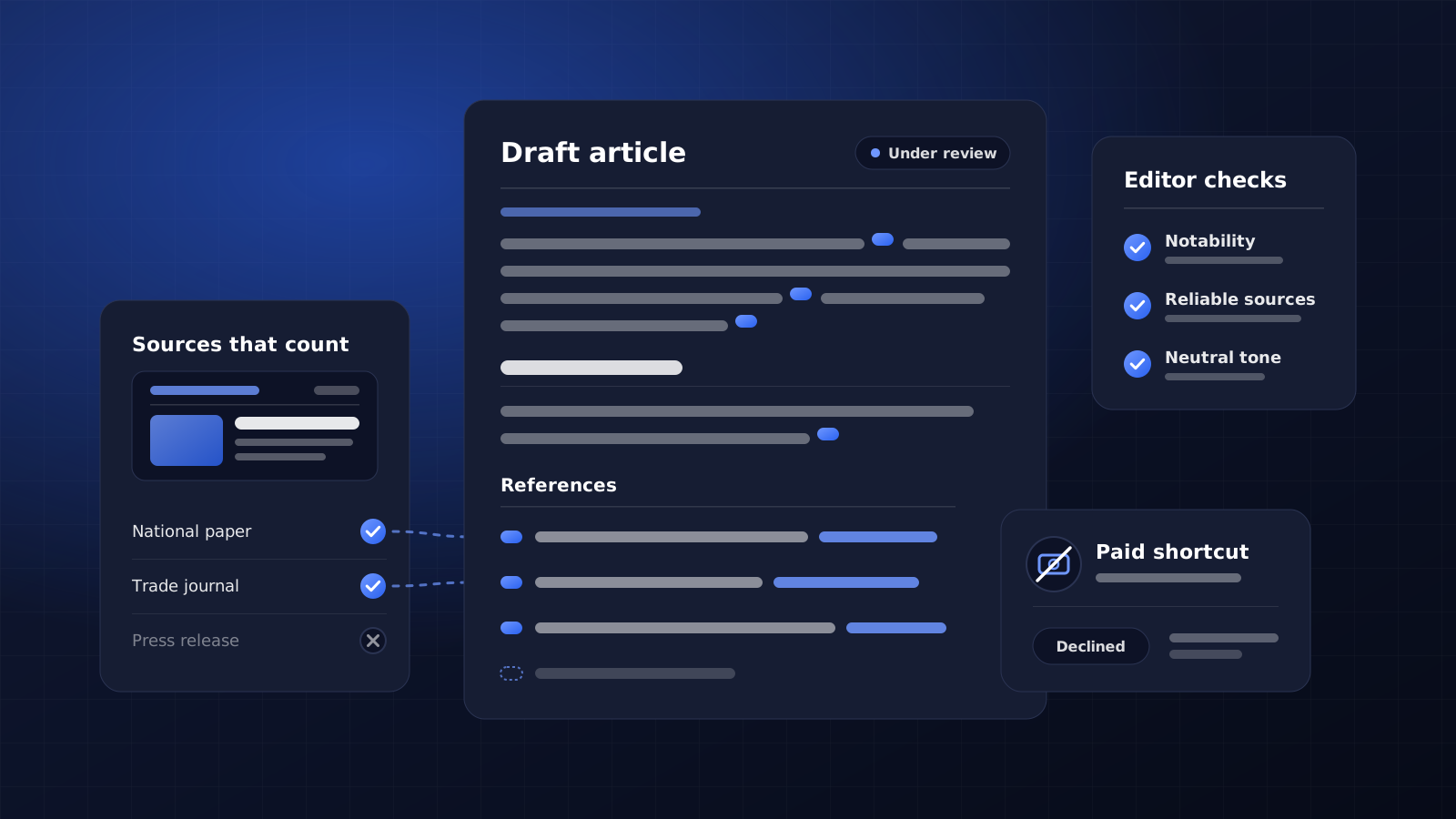
To get a Wikipedia page, you or your company first need in-depth coverage in several reliable publications that have no ties to you. Volunteer editors then have to accept a neutral article built from that coverage. Most early-stage founders do not clear that bar yet, and a page written too early will not survive review.
01.How Wikipedia decides who gets a page
Wikipedia has no interest in your revenue or the size of your last round. Its editors check one thing: whether people with no ties to you have already written about you at length. The notability guideline for companies asks for in-depth coverage in multiple reliable secondary sources that are independent of the subject, and it says a single strong source is almost never enough.
Each source has to pass four tests at the same time:
- Significant: the piece is about your company and goes into detail, instead of naming you once in a roundup.
- Independent, which rules out anything written or paid for by a client, investor, partner or hired writer.
- Reliable: it comes from a publication with editors and a record of checking facts.
- Secondary, so the writer analyses what happened instead of passing on what you told them.
Founders face an extra hurdle. Wikipedia's guideline on people wants sources that are independent of each other as well as of you, and it states that relationships do not confer notability. So a founder whose company gets plenty of press still needs articles about them personally.
02.Coverage that does not count towards notability
Most founders who think they qualify are counting the wrong articles. The company guideline excludes whole categories of press, and the average startup press folder is full of them:
- Announcements of a funding round, a senior hire, a product launch or a new office, even in a respected outlet.
- Stories built on your press release, including ones a reporter rewrote in their own words.
- Paid or sponsored posts, plus pieces by non-staff contributors to Forbes, Entrepreneur.com, Inc.com and TechCrunch, which the guideline names.
- Your quotes inside someone else's story, and interviews in which you describe your own business.
- Directory entries and simple lists of companies in a sector.
- Anything published by you, your team, your investors or anyone closely tied to the company.
Take a fintech founder with 40 press mentions. Strip out the funding news, launch stories, contributor posts and quotes, and three or four articles might be left. Those few decide the outcome.
03.Test your sources before anyone writes a draft
Do this before you spend a pound or a dollar on a draft. Open a spreadsheet and list every article that mentions you or your company, with the outlet, date, writer and link.
Then put each one through the four tests and the excluded list above, and mark it as a pass only if it clears every test. The guideline judges each source on its own, so five weak articles do not add up to one strong one.
Wikipedia sets no fixed number of sources. One is almost never enough, and if your sheet shows fewer than two or three passes, you are not ready yet. That is normal for a company a few years old, and we would rather you learn it from a spreadsheet than from a public deletion discussion.
Wikipedia records what independent writers have already said about you. It comes after the coverage, never before it.
The work now is earning coverage that passes: a reporter examining your market, your results or a hard decision you made, in a publication your buyers read. Our guide to getting press coverage as a founder shows how to pitch for it.
04.Why writing your own page backfires
Wikipedia's conflict of interest guideline strongly discourages people from editing articles about subjects they are connected to. It also says you should avoid creating a Wikipedia page for yourself, or anyone you know, unless it goes through the Articles for Creation review, where a volunteer checks the draft before it goes live.
Editors spot self-written pages fast. The tone glows, the facts trace back to the company website, and the awards list includes prizes nobody independent reported. Wikipedia's own page on autobiographies says self-created articles are frequently nominated for deletion, and that the comments in those discussions can be "most uncomplimentary".
Surviving review brings its own problem. Once the page is live, anyone can add the lawsuit, the layoffs or the product you shut down, as long as a reliable source covered it, and you will be expected to leave it there. The autobiography page warns that many such articles become "a source of dismay" to the people who started them.
05.What paid Wikipedia writers can and cannot do
Wikipedia permits paid editing only with disclosure. The writer has to state who pays them, on whose behalf the edits are made and any other affiliation, which the Wikimedia Foundation's terms of use also require, and the draft should still go through review instead of straight onto the site.
No writer can create notability for you. A paid editor works from the same articles in your spreadsheet, and if those fail the tests, a polished draft fails with them.
Fraud is the larger risk. Wikipedia publishes a scam warning about people who pose as volunteers, administrators or PR firms, contact founders on LinkedIn, WhatsApp, email or phone, and target people whose drafts were just declined. Its wording is blunt: "No one can guarantee that an article will be accepted or protected; any such guarantees are lies."
Walk away from any offer that includes one of these:
- A promise that the page will be approved, backed by a refund.
- Claims of administrator powers or a contact inside Wikipedia.
- A monthly fee to protect your page from edits or deletion.
- A first message from a stranger soon after your draft was turned down.
- No mention of disclosing who is paying for the work.
06.How to get a Wikipedia page the proper way
If your sheet shows enough passing sources, the cleanest route is an independent editor writing the page. Wikipedia keeps a public list of requested articles, but volunteers choose what to write and nothing obliges anyone to pick yours.
Writing it yourself is allowed if you do it in the open:
- Register an account and state your connection to the company on your user page before your first edit.
- Draft from the passing sources only, in a flat, neutral tone, with a citation on every claim.
- Leave out anything that only your own website or LinkedIn can confirm.
- Submit through Articles for Creation, then answer reviewer comments on the draft's talk page.
Reviewers give one of two verdicts. Declined means the draft is not ready but the problems may be fixable, so you add sources and resubmit. Rejected means the reviewer considers the subject unsuitable for Wikipedia, with little prospect that more work will fix it, and sending the same draft again will not change that answer.
07.A Knowledge Panel does not need Wikipedia
Many founders want a Wikipedia page because of the box that appears next to their name on Google: the Knowledge Panel. Plenty of panels carry a short description with a Wikipedia link under it, which is where the belief that you need an article comes from.
Google's help page on knowledge panels says panels are generated automatically from various sources across the web, including data partners, and it does not list Wikipedia as a requirement. People with no article at all have panels too.
The signals that help are the ones you can act on today: a founder bio people can check on a site you own, profiles that use the same name and description, and mentions in publications Google already trusts. Our post on how to get a Google Knowledge Panel covers each step, and the press you earn along the way is what a Wikipedia reviewer will ask for later.
If you would like help building those signals, our Knowledge Panel setup team can look at where you stand on a free call.
Frequently asked questions
How long does an Articles for Creation review take?
Wikipedia sets no fixed waiting time. Reviewers are volunteers, drafts are not always reviewed in the order they arrive, and some get a decision quickly while others wait considerably longer. Plan in months rather than weeks, and check before you submit that every claim carries a citation, since a reviewer will send back a draft built on claims nobody independent has published.
Can a friend or an employee write my Wikipedia page instead?
Asking them moves the conflict of interest rather than removing it. An employee, investor, agency or close friend has a connection to you, so the same guideline applies: they should disclose the link and submit through Articles for Creation. An employee who writes it as part of their job is a paid editor and has to name their employer and the company the edits are for.
What can I do if a Wikipedia page about me has errors?
Post on the article's talk page, say who you are, describe the error and link a reliable source that shows the correct fact. The conflict of interest guideline provides an edit request template for this, so an independent editor reviews the change. Clearly defamatory or unsourced negative claims about a living person are the exception, and you can remove those yourself while explaining why on the talk page.
Is a Wikidata entry an easier route than a Wikipedia article?
Wikidata, Wikimedia's structured database, accepts items about clearly identifiable people and organisations that can be described using serious, publicly available references, so its bar sits lower than Wikipedia's. An entry there does not create an article or prove notability, and volunteers can still challenge items through its deletion requests. Treat it as a tidy record of public facts about you, written to the same neutral standard.