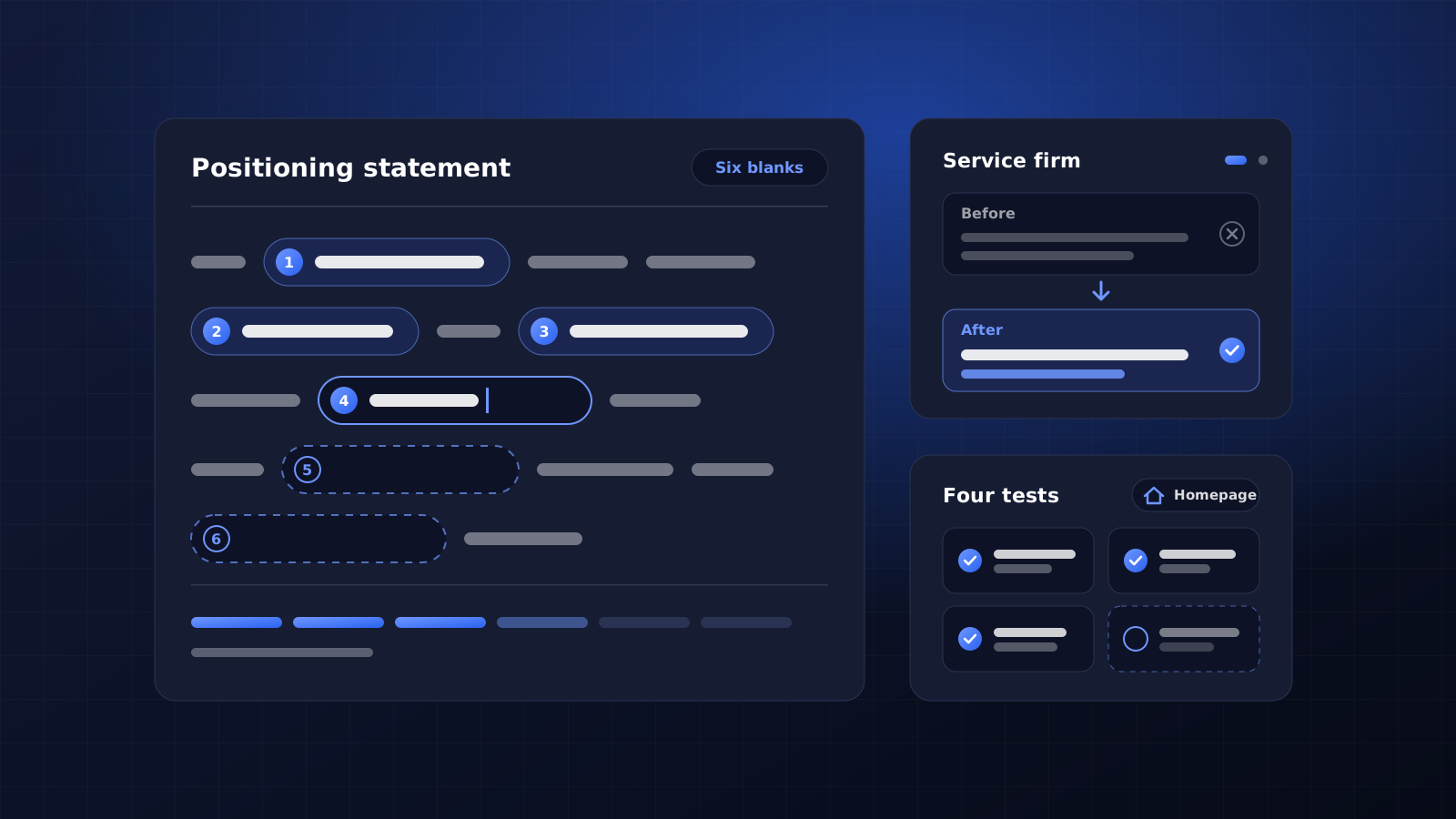
A brand positioning statement is one or two sentences, kept inside your business, that name who you serve, the problem you solve, what they would do instead of hiring you and why you are the better choice. Build it from your customers’ own words, then test it before it touches your homepage.
01.What a positioning statement is for
Nobody outside the business needs to read your positioning statement. It is a decision written down, so the homepage, the sales call, the LinkedIn profile and the proposal all describe the same company to the same buyer.
Many founders skip it because it looks like a marketing exercise. The cost turns up later, usually as a homepage that lists eleven services and a pipeline full of leads nobody wanted.
Two other lines get mixed up with it. A tagline is public and written to be remembered, and a mission statement explains why the company exists. Positioning sits underneath both and decides who the business is for, which is why it comes first.
02.A brand positioning statement template with six blanks
The templates you will find online mostly descend from the one Geoffrey Moore set out in Crossing the Chasm. This is the version we use with founders of service businesses:
For [customer], who [problem in their words], [your firm] is the [category they already know] that [main result]. Unlike [what they would do instead], we [proof they can check].
Each blank has a job, and each one fails in a predictable way.
- Customer. A group narrow enough that you could name 20 of them. “Small businesses” fails, while “UK dental practices with three to six chairs” passes.
- Problem. Written the way a buyer says it on a first call, such as “we only see our margins a month later”, instead of your internal label for it.
- Category. The shelf a buyer already looks on, such as bookkeeping firm or fractional CFO. Invent a new category and you spend every sales meeting explaining it.
- Result. One outcome the customer would pay for, stated as a change in their week or their numbers.
- Alternative. What they would do if you did not exist, which for many service firms is hiring someone in-house or doing nothing.
- Proof. Something a sceptical buyer can check, like a narrow specialism or a fixed weekly turnaround. “Great service” and “attention to detail” do not count, because every competitor says them.
03.Start with your last ten customers
Positioning written in a workshop sounds like a workshop. Positioning written from sales calls sounds like your buyers, and that version is the one that holds up on a homepage.
Pull the last ten deals you won and the last five you lost. For each one, open the emails, call notes or proposal and write down four things:
- The words they used for the problem before you said anything.
- Who else they spoke to, including “we thought about doing it ourselves”.
- The moment they decided, and what tipped it.
- Anything that nearly stopped them, whether price or a doubt about how well you knew their sector.
Then ring five recent clients and ask one question: “What would you have done if we had not been around?” Their answers fill the Alternative blank faster than any competitor audit.
Look for words that repeat. When three clients describe the problem with the same phrase, that phrase goes into your statement. If every answer is different, your customer group is still too wide, so narrow it before you write a word.
04.Name the competitor buyers would choose instead
Ask founders who they compete with and they name the three agencies they lose pitches to. For a service business the bigger rival is quieter: the client’s own team, a freelancer found through a friend, or leaving the problem alone for another year. For example, a payroll bureau pitching a 40-person firm is up against the office manager who runs payroll on the last Friday of every month.
That choice sets your frame of reference, the category buyers compare you within. Kevin Lane Keller, Brian Sternthal and Alice Tybout argue in Harvard Business Review that a point of difference is not enough on its own: a brand also has to match the basics buyers expect from its category. A brand studio that misses deadlines will not win on taste.
The alternative you pick changes the whole statement. If buyers would otherwise hire in-house, your proof is speed and experience across many clients. Next to a freelancer, it is cover when someone is off sick. Doing nothing is the hardest rival to beat, and the only proof that works there is the cost of one more year with the problem, priced in the client’s own numbers.
05.Two positioning statement examples, before and after
Both examples below are invented, so no real client details are involved.
A bookkeeping firm’s first draft reads: “For small businesses who need help with their finances, Ledgerline is an accounting firm that provides high-quality, personal service.” Every accountant in the country could sign that.
The second draft: “For owners of independent restaurant groups with two to eight sites, who learn their food margins a month too late, Ledgerline is the bookkeeping firm that closes your books every Monday. Unlike a general high-street accountant, we only work with hospitality, so supplier invoices and rota costs are checked by people who see them every week.”
You could list every restaurant group that fits, the problem is one owners say out loud, and a buyer can test the proof in the first conversation by asking about a single supplier.
The template works for a founder’s own name too, which matters because investors and hires search for you before a meeting. A fictional fintech founder might write “Priya Shah is an experienced leader in financial services.” A sharper version says “For seed investors who back UK payments start-ups, Priya Shah is the founder who spent eight years running card fraud operations at a large UK bank, so the company’s risk model comes from incidents Priya handled first-hand.” There is more on that side in our guide to personal branding for founders.
06.Test the statement before anyone sees it
None of these checks takes more than an hour, and every one should happen before the statement reaches your website or your team.
- Put a competitor’s name in place of yours and read it again. If it is still true, the Proof blank needs work.
- Read it aloud to two clients. “Yes, that is us” is a pass; a polite “sounds good” means the Problem blank is in your words and not theirs.
- Name one lead you would now turn down. When nothing comes to mind, the Customer blank is too wide.
- Hand it to someone who has never heard of you, take it back after one read, and ask them to say what you do in a sentence.
A positioning statement earns its keep the first time it helps you turn down a client who would have been a poor fit.
07.Where the statement shows up in your business
The statement stays internal, but every public line you write should trace back to it. Start with the homepage. Research from Nielsen Norman Group shows that visitors decide in the first 10 seconds whether a page is worth staying on, and many leave within 10 to 20 seconds. Your headline should carry the Customer and Problem blanks, and the line under it the Result.
Buyers check the founder as well as the firm. Your LinkedIn headline and founder bio should name the same customer as the homepage, in the same words. When the company says “restaurant groups” and the founder’s profile says “SMEs”, a careful prospect notices.
On sales calls, spend the first two minutes on the Problem and the Alternative before any slide about your team. In proposals, the Proof blank becomes the paragraph a buyer forwards to a colleague. Even the tone section of your brand style guide should be written for the buyer the statement names.
Positioning keeps working when nobody is buying. The LinkedIn B2B Institute’s 95-5 rule, based on research with the Ehrenberg-Bass Institute, puts the share of business buyers ready to purchase at any moment at about 5 per cent. The other 95 per cent buy later, and a clear, repeated description of their problem is what puts your name on their list when they do.
Common mistakes to avoid
Many drafts try to cover every service. A statement that spans eleven offers positions none of them, so pick the offer you want more of and leave the rest on the services page.
Values make poor proof. Honesty and quality are the minimum buyers expect, which puts them with the basics you have to match. Big-brand examples mislead in a similar way: Nike and Volvo can position on a feeling because millions of people already know them, while a 12-person firm needs a reason a stranger can check.
The last two faults show up months later. The company statement names one buyer while the founder’s profiles still describe the old business, or the first draft gets filed away as finished. Reread it after your next five sales calls and change any word a buyer contradicted.
For a second opinion on your draft, our brand strategy service starts with these questions.
Frequently asked questions
How often should you update a brand positioning statement?
Review it once a year, and sooner if something big shifts, such as a new service line or a run of lost deals to a competitor you had not listed. Small wording changes are fine at any time. Changing the Customer blank is a bigger decision, because the homepage, sales deck and founder profiles all need to follow it within a month.
Do you need a separate positioning statement for each service?
Usually not. One statement should cover the business, with the main service in the Result blank. If a second service sells to a different buyer with a different problem, write a short statement for that line as well, and check the two do not contradict each other on your homepage. Three or more statements for a small firm is a sign the offer itself needs narrowing.
Can AI tools write a positioning statement for you?
They can turn your notes into ten variations in a minute, which helps with wording. They cannot choose your customer or know what buyers said on last month’s calls, and those two decisions are most of the statement. Give the tool your own call notes and client phrases, then read whatever it produces to two clients before you use it.