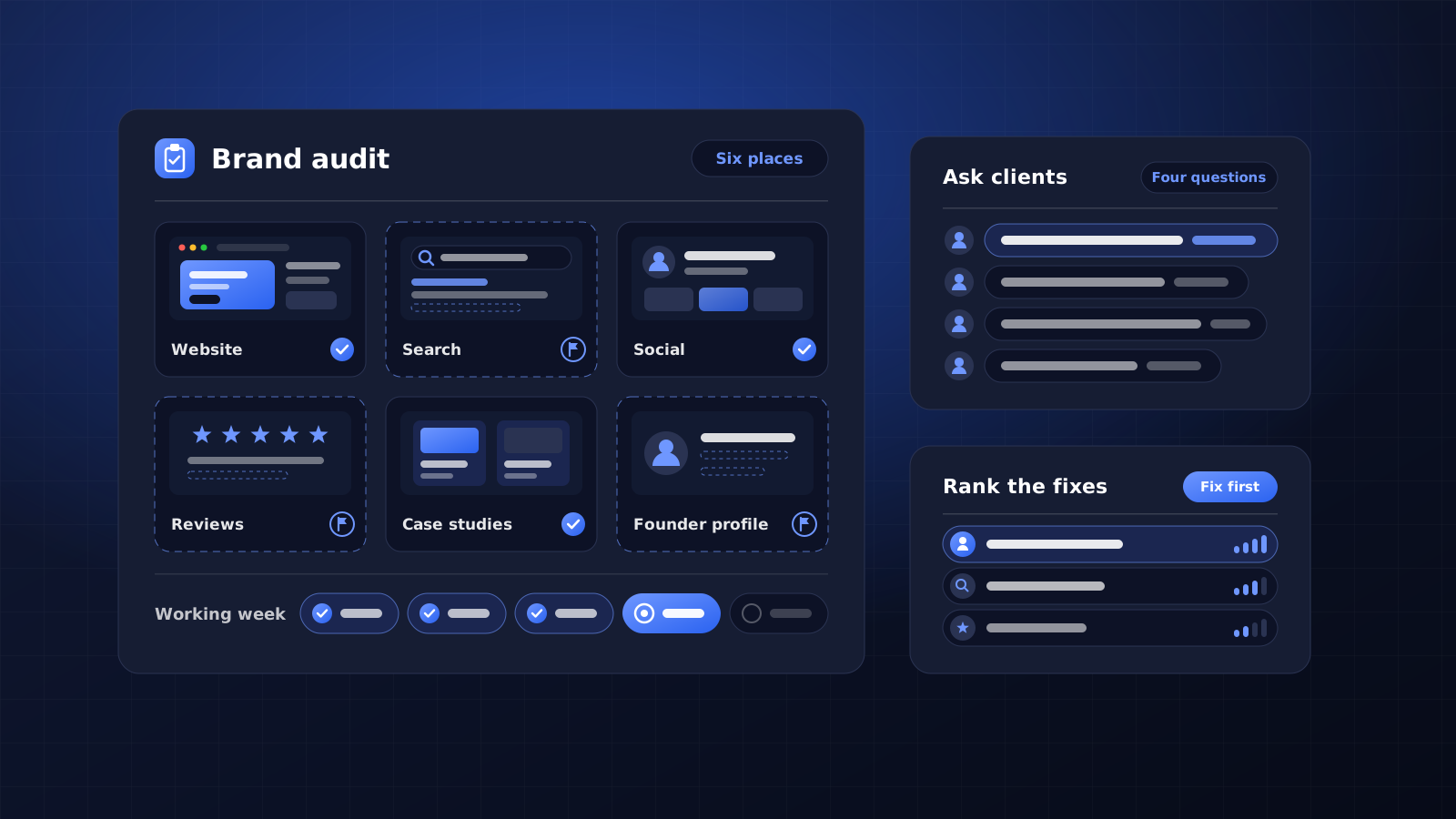
To do a brand audit, list every place a buyer meets your business, score each one against what you want to be known for, and fix the gaps in the order buyers see them. For a founder-led service business, the whole audit fits into about five working days, and you can run it yourself.
01.What a brand audit covers for a service firm
A brand audit compares what you want people to believe about your business with what they can see and hear when they check. Each gap goes on a list with a fix next to it, and that list is the whole output.
Most guides to a brand audit for small business owners borrow from consumer brands, so they cover packaging, staff culture and social listening tools. A founder-led service firm has fewer places to check and more riding on each one: the Google results for the company and for the founder, the homepage, LinkedIn, the proposal and the first minutes of a sales call. Buyers of services hire people. Half of this is a personal brand audit.
None of this is new. In January 2000, Kevin Lane Keller's Brand Report Card in Harvard Business Review graded brands on ten traits, and the tenth was that the company keeps checking where its brand's value comes from. A five-person consultancy needs the same habit, with a spreadsheet in place of a research budget.
The audit measures the distance between what you meant to say and what a buyer can find in ten minutes.
02.Signs your brand needs an audit now
Some moments make an audit urgent, because a mismatch costs more than usual. Run one when any of these is true:
- You are about to raise money, sell the business or hire a senior person, and each of them will search for you before the first meeting.
- Enquiries keep asking for a service you stopped selling, or for a price range you left behind two years ago.
- You added a service line or moved into a new sector after the website was written.
- A redesign quote is on your desk. Audit first, so the brief fixes the problem buyers have and not the one that annoys you most.
- Prospects who seemed keen go quiet after the first call.
Silence after a good call is the sign founders ignore most. Between that call and your proposal, the buyer looked you up, and what they found either matched what you said or raised a doubt they never put in an email.
03.Write down what you want to be known for
Start with your intent. Without it you will score everything on taste, and taste changes with your mood, so write this part before you open a single page.
Write one sentence that names who you serve, the problem you fix and the result a client would repeat to a colleague. If you already have a brand positioning statement, copy it in. A sentence that runs past 30 words or names four kinds of customer is your first finding, and no tidying elsewhere will cover for it.
Then list the facts that should read the same everywhere:
- The company name exactly as you want it written, including any Ltd, LLC or trading name.
- What the firm does, in words a client would use on the phone.
- The founder's name, job title and a one-line description.
- Who you work with and where, such as UK dental practices or US software firms with 20 to 200 staff.
- The contact email, phone number and booking link that work today.
This page is the answer sheet for the rest of the audit, so keep it open while you work.
04.Six places to check in a brand audit
Open each place the way a stranger would, on a phone and in a private browser window. Spend about ten minutes on each and copy what it says now, word for word where you can.
- Google results for your company name. Read page one and the site name Google shows above your homepage result. Google picks that name automatically from your homepage and from how other sites mention you, and its site name guidance shows how to suggest one with structured data. An old trading name on a directory can still win.
- Google results for the founder's name. Investors and senior hires search the person before the firm. Note anything outdated or written by someone else, plus anything a buyer would expect to find and cannot. Our guide to ranking your name on Google covers the fixes.
- The homepage, first screen only. On a phone, read what shows before any scrolling. A stranger should be able to say who the firm is for and what happens after they press the button.
- The founder's LinkedIn profile and website bio. Put the headline, the About section and the bio side by side. Three slightly different versions of the same person is a common finding, and a founder bio people can check fixes it at the source.
- The last proposal and pitch deck you sent. Retired services, the old logo and a different company description survive longest here, because nobody outside sales opens these files.
- Reviews and directory listings. Check your Google Business Profile, the review sites in your sector and any trade directories, including the ones you forgot you joined.
Take a dated screenshot of each one. In six months you will want the before picture, and nobody remembers what the old homepage said.
05.Check what people search to find you
If your website is connected to Google Search Console, its Performance report lists the searches that showed your pages, with clicks and impressions for each. Filter the queries to those containing your company name and set the dates to the last 12 months.
Read the words people add to your name. Seeing “Harbour & Co accountants” and “Harbour & Co recruitment” in the same report means two groups of buyers have filed you under different trades. A branded search with plenty of impressions and few clicks points to a results page that looks wrong or unclear, which sends you back to the first item on the checklist.
Searches that pair the founder's name with “LinkedIn” or “reviews” show people checking the person before they buy. Setting up Search Console is free and needs access to your domain or website settings. Do it now even if the rest of the audit waits, because the report needs a few weeks of history before it says much.
06.Ask five clients how they describe you
Keller's eighth trait was that the people running a brand understand what it means to customers, and in a service firm the quickest way to learn that is to ask. Pick five clients from the past year and one prospect who chose someone else, and ask each for 15 minutes on a call.
Use the same questions each time and write down their exact words:
- How would you describe what we do to a colleague who has never heard of us?
- What did you check about us before the first call, and where?
- What nearly stopped you from going ahead?
- For the prospect who said no: what made the other firm feel like the safer choice?
Put their phrases next to your homepage. When a client says you “sorted out our month-end mess in six weeks” and the homepage says “financial clarity for growing businesses”, the client's version wins. It is the phrase the next buyer will recognise, because it describes their problem in their words.
Ask a colleague to sit in on your next three sales calls as well and note how you describe the firm in the first two minutes. Founders drift further from their own website than anyone else in the business.
07.Score each gap and rank the fixes
Score every touchpoint 0, 1 or 2 against the answer sheet you wrote at the start. Be strict. Give a 2 when it matches your intent and every fact is current. A homepage listing eight services when clients buy two of them gets a 1, because the facts are right while the message drifts. Anything wrong, missing or out of date scores 0, from the old logo on a proposal to a booking link that goes nowhere.
The brand audit template can be a plain spreadsheet with five columns: the touchpoint, what it says now, the score, the fix and the person who owns it. Rank the fixes by how many buyers see each place and how early in their decision. A 0 on page one of Google outranks a 1 in a deck you send twice a month.
For most founder-led firms the order comes out like this:
- Wrong facts anywhere, fixed this week, since a wrong title or a dead link costs trust in seconds.
- The homepage first screen and the founder's profiles, which nearly every buyer sees.
- Proposal and deck templates. Fix them once and every future proposal goes out right.
- Visual consistency last. It bothers you more than it bothers buyers, and a brand style guide your team will use stops it creeping back.
Put a date next to every fix. An audit without owners and dates becomes a document everyone agrees with and nobody opens again.
Common mistakes to avoid
Auditing only the visuals is the easiest mistake to make. A tired logo jumps out at you, and it is rarely the reason a buyer said no. Watch for these as well:
- Scoring from memory, when what you remember is the version you approved months ago.
- Asking friends to describe you. They describe the person, while clients describe the firm they paid.
- Starting with the easy fixes. A new favicon feels like progress while a wrong job title on page one of Google keeps costing you meetings.
The last mistake is doing it alone. A second scorer from outside the business, even a client you trust, catches what you stopped seeing a year ago. If the audit shows the positioning itself is the problem, our brand strategy and building team can help you fix that first.
Frequently asked questions
Is a brand audit the same as a rebrand?
No. The audit is a check, and a rebrand is one possible answer to what the check finds. Most audits of founder-led firms end with a list of edits, such as a rewritten homepage first screen, updated founder profiles and a new proposal template. A new name or visual identity is worth discussing only when the business itself has changed, for example after a move into a different sector, and the old brand can no longer describe it.
Should a brand audit include competitors?
Yes, in a narrow way. Look at the homepages and Google results of three firms a buyer would compare you with, and list the phrases they all use. Those shared phrases show what buyers already assume about every firm in your field, so they cannot be your reason to be chosen. Leave their design and structure alone; the useful output is a list of claims you should stop making.
How often should a small business do a brand audit?
Once a year suits most small service businesses, with an extra check before any moment when people will look you up closely, such as a fundraise or a senior hire. Keep the spreadsheet and screenshots from the first round. The second audit takes about a day, because you only check what changed since last time and whether the fixes held.