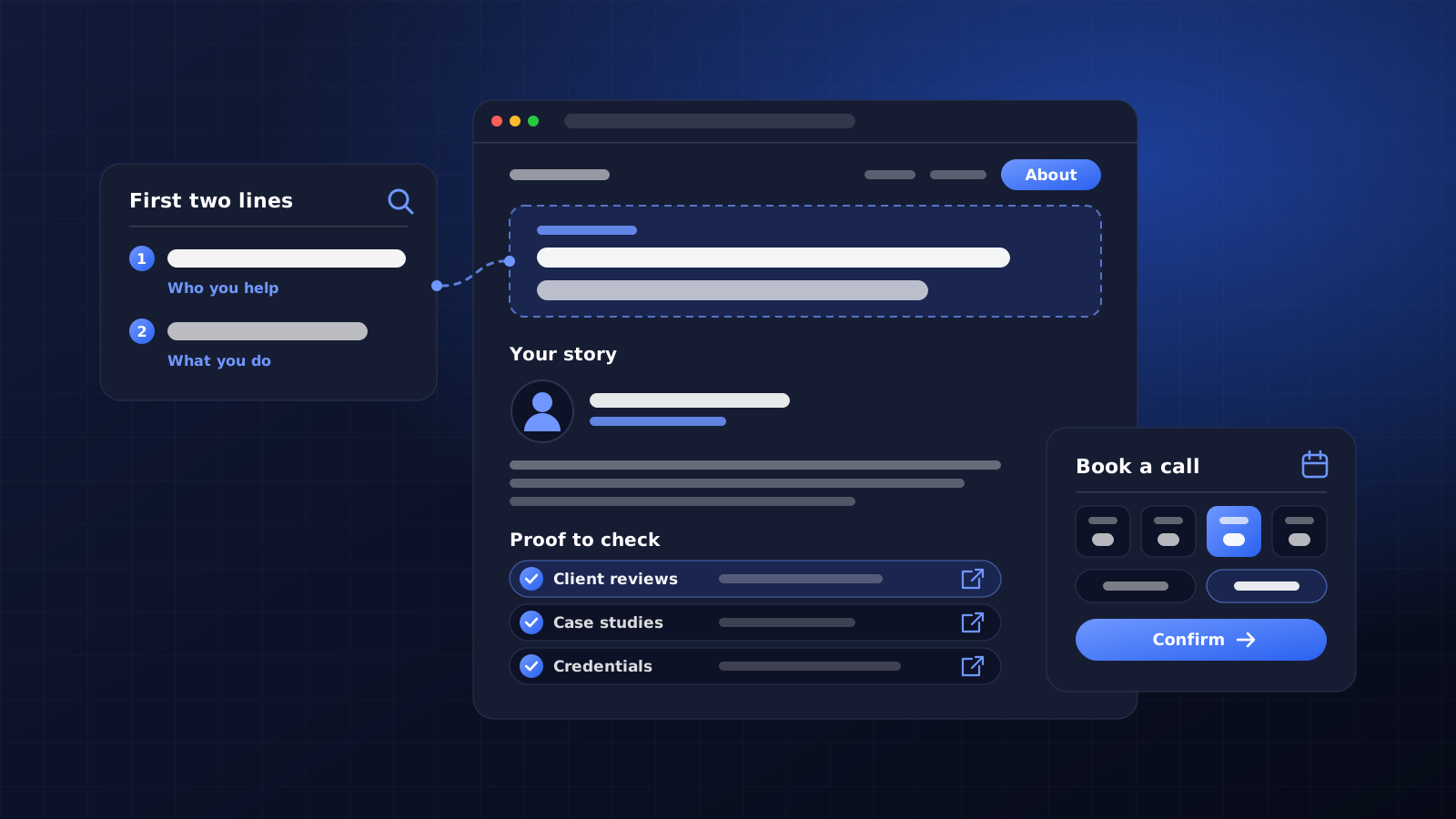
To write an About page that wins work, answer what a buyer checks before booking a call: who runs the business, what you do and for whom, and why they should believe you. Put those answers in the first two short paragraphs. Then back every claim with a name, a date or a link the reader can check.
01.What buyers look for on an About page
A buyer usually lands on your About page after seeing your homepage or hearing your name from a colleague. At that point they are deciding whether a first call with you is worth their time, and they want to know who they would be dealing with.
Nielsen Norman Group's research on About Us pages watched more than 70 people use company websites. People went to About content to size up possible suppliers, and they were sceptical of what companies said about themselves. Many left the site to look for reviews on Google and other platforms before making up their minds.
Read your current page the way a stranger would, on a phone, and see whether it tells them four things:
- Who runs the business, by name and with a photo.
- What the firm does, for which clients and in which countries.
- How a project runs after the buyer says yes.
- Whether any of it can be confirmed somewhere else. Reviews, press coverage and a company register all count.
02.Open with what you do and who it serves
Write the first two sentences as if they are the only lines a visitor will read, because on a phone they may be. They need three facts: the service, the client and the place.
Here is a common opening: "Founded on the belief that every business deserves better, we bring years of experience and a commitment to quality to everything we do." It could belong to any firm in any industry. Compare an opening for a made-up bookkeeping firm: "Halden Bookkeeping handles the accounts and payroll for restaurants and cafés in Greater Manchester. A team of six has run hospitality books since 2014."
Trouble writing those two sentences points to a gap upstream of the About page. A brand positioning statement settles who you serve and how you differ, and the About page repeats it in plainer words.
Under the summary, add the facts a buyer would otherwise email to ask: when you started, where the team works, which time zones you cover and how quickly you reply. A firm in Pune or Leeds selling to clients in Chicago should say which of its working hours overlap with Chicago's, because a US buyer will ask.
03.Put the founder's name and face on it
Service buyers hire people. A page that talks about "our team" without a single name makes the reader wonder how small or how new the business is, and a stock photo of a meeting room confirms the worry.
Use a recent photo of the founder in decent light, with the name and role underneath. Then add a bio of 80 to 150 words: what the founder did before, why they started this firm and which part of client work they still do themselves. Leave out childhood stories and hobbies unless they explain the work.
Keep every fact identical to the founder's LinkedIn profile, down to the job title and start dates. Buyers open both tabs. A mismatch looks careless, even when the reason behind it is innocent. Our post on writing a founder bio people can check has short and long versions ready to adapt.
Give each person who talks to clients a name, a photo and one line on what they handle. Staff who work behind the scenes can share a single line. A small team is not an issue for most buyers; an anonymous one is.
04.Replace adjectives with proof buyers can check
Words like trusted, experienced, friendly and results-focused cost nothing to type, so readers skip them. Swap each one for a fact a stranger could confirm without asking you.
- "Years of experience" becomes the year you started and what you did before that.
- Name the clients behind "trusted by leading brands", with their permission and a link to the work.
- An award only counts with its name, its year and the body that gave it.
- "Featured in the press" works better as links to the articles than as a strip of outlet logos.
Readers skip adjectives they cannot check. Give them a year, a name or a link instead.
Nielsen Norman Group counts being connected to the rest of the web as one of four credibility factors for websites. On an About page, that means linking out to your Google reviews, a case study on a client's own site, a podcast episode or the article that quoted you. A link you are happy to send people to says more than a quote you pasted in yourself.
UK limited companies already have one checkable fact to show. GOV.UK guidance for limited companies says the website must give the registered number, the registered office address and where the company is registered. The footer is the usual home for these details. Repeating them on the About page helps the buyer who is about to look you up on Companies House.
Founders with no clients they can name yet can show other things: work from a previous role, a project described without the client's name, or a free guide people can judge for themselves. A modest claim that holds up beats a big one that falls apart.
05.Show how a project runs from first call
Liking the founder is half the decision. The other half is knowing what happens next, and few About pages say.
Describe the process in four to six steps with rough timings. A web studio might write: a 30-minute call, a written proposal within five working days, a fixed quote, two rounds of design changes, then launch about six to ten weeks after the start.
Say who the client deals with day to day, how you keep them updated and what you will not do. A line such as "We take on no more than four builds at a time" tells a buyer more about your standards than a paragraph of values.
The same Nielsen Norman Group article names upfront disclosure as another credibility factor. Link to any price ranges or minimum project size you publish elsewhere on the site, so the buyer does not have to ask.
06.Help Google connect the page to your business
An About page rarely ranks for buying searches such as "web designer for law firms". Its search job is to tell Google, and the people Google sends, who stands behind the rest of the site.
Google's guidance on creating helpful, reliable content asks whether a site gives background about who publishes it, and names the About page as one place to do that. Link to it from the main menu or footer, and from the author line on each blog post.
Add Organization structured data to the page. Google recommends placing Organization markup on the home page or on a single page that describes the organisation, such as an About page. Include your legal name, logo, address and a sameAs list that points to your LinkedIn company page and other official profiles.
Give the page a title tag that names the business and what it does, such as "About Halden Bookkeeping | Restaurant Accounts, Manchester", instead of a bare "About Us". Founders more worried about the search for their own name can start with our post on ranking your name on Google.
About page mistakes that cost enquiries
Run your current page past this list before you rewrite anything.
- A mission statement in the first line, before the reader knows what you sell.
- Team photos with no names, or names with no roles.
- Client logos that link nowhere, with no sign you were allowed to use them.
- LinkedIn says the firm started in 2019 and the About page says 2018.
- The only contact link sits in the footer, so a reader who is ready to talk has to hunt for it.
Finish the page with one plain next step, such as a link to book a call and the time it takes you to reply. When the About page is one of several pages that need work, our website design team can look at the whole site with you.
Frequently asked questions
How long should an About page be?
For most service businesses, 400 to 900 words is enough: a two-sentence summary at the top, a founder section, proof and how a project runs. Order matters more than length. A buyer who only reads the first screen should still learn what you do, who it is for and who runs it. Cut any paragraph a competitor could paste onto their own site unchanged.
Should an About page be written in the first or third person?
Write in the first person: "we" for a team, and the singular form if you work alone. Both read as people talking. Third person ("The firm was founded in 2018 by its two partners") suits a press kit or a speaker introduction, but on your own site it sounds as if someone else wrote it for you. Pick one and keep it the same across the page.
Do solo founders need an About page or an About Me page?
If you sell your own expertise under your own name, an About Me page is the honest choice and can carry your full bio. If the business has its own name and you plan to hire, call it About and write it as the business, with you as the founder. Mixing the two leaves visitors unsure whether they are hiring a person or a firm.
How often should you update an About page?
Review it every six months, and straight away when something a buyer would look up changes: a new service, a new hire who talks to clients, a new office, a press mention or a new LinkedIn title. Put the review in your calendar. A page that still shows someone who left a year ago makes the reader ask what else is out of date.